

What are Fluoropolymers and why are they used in Cable Manufacturing
Fluoropolymers are a family of high-performance polymers widely used in wire and cable extrusion where exceptional thermal stability, chemical resistance, dielectric performance and flame resistance are required. They are especially important in industries such as aerospace, telecommunications, oil & gas, industrial automation and high-temperature electronics.
Fluoropolymers Used in Cable Extrusion
Fluoropolymers are critical materials in advanced wire and cable systems due to their superior thermal, electrical and chemical performance compared with conventional polymers such as PVC or polyethylene. This article reviews the primary fluoropolymers used in cable extrusion—including PTFE, FEP, PFA, ETFE, ECTFE and PVDF – focusing on their chemical structure, processing characteristics, mechanical and electrical properties and typical applications. The study also compares their extrusion behavior and suitability for different cable environments.
Can't find what you need?
CTA Banner Form
1. Introduction
Wire and cable systems operating in extreme environments require insulation materials capable of maintaining electrical integrity under high temperatures, aggressive chemicals and mechanical stress. Fluoropolymers are a class of polymers containing carbon-fluorine bonds, one of the strongest bonds in organic chemistry. This bond provides:
- High thermal stability
- Low friction
- Chemical inertness
- Excellent dielectric properties
- Flame resistance
Because of these characteristics, fluoropolymers are commonly used for high-performance cable insulation, jacketing and plenum-rated cables.
2. Overview of Fluoropolymer Materials
Fluoropolymers differ primarily in their molecular structure and degree of fluorination, which directly influences melt processability and mechanical performance.
They can be divided into two groups:
Melt-processable fluoropolymers
These materials can be extruded using conventional thermoplastic extrusion equipment.
Examples:
- FEP
- PFA
- ETFE
- ECTFE
- PVDF
Non-melt-processable fluoropolymers
These require special processing such as paste extrusion or sintering.
Example:
- PTFE
3. Polytetrafluoroethylene (PTFE)
Structure
PTFE consists of repeating –CF₂–CF₂– units.
Key Properties
- Continuous temperature rating: 260°C
- Melting point: ~327°C
- Dielectric constant: ~2.1
- Extremely low coefficient of friction
- Outstanding chemical resistance
Processing Method
PTFE cannot be melt extruded because it does not flow in the molten state. Instead, it is processed using:
- Aerospace wiring
- Military cables
- High-frequency RF cables
- High-temperature instrumentation cables
Advantages
- Best thermal stability among fluoropolymers
- Exceptional dielectric properties
- Non-flammable
Limitations
- Difficult processing
- High cost
- Lower abrasion resistance
4. Fluorinated Ethylene Propylene (FEP)
FEP is a copolymer of hexafluoropropylene and tetrafluoroethylene.
Key Properties
- Temperature rating: 200°C
- Melting point: ~260°C
- Dielectric constant: ~2.1
- Excellent flame resistance
- Transparent material
Extrusion Characteristics
FEP is fully melt-processable and can be extruded using conventional single-screw extruders.
Typical processing parameters:
- Melt temperature: 340–380°C
- Screw design: corrosion-resistant alloys
- Crosshead extrusion recommended for uniform insulation
Cable Applications
- Plenum communication cables
- Data cables
- Coaxial cables
- High-speed signal cables
Advantages
- Excellent dielectric properties for high-frequency transmission
- Smooth surface finish
- Good flexibility
Limitations
- Moderate mechanical strength
- Higher cost than conventional thermoplastics
5. Perfluoroalkoxy (PFA)
PFA is similar chemically to PTFE but includes perfluoroalkoxy side chains, allowing melt processing.
Key Properties
Continuous temperature rating: 260°C
Melting point: ~305°C
Excellent creep resistance
Superior stress crack resistance compared with FEP
Extrusion Characteristics
Processing temperatures:
360–400°C
Equipment considerations:
- Nickel-based alloys for corrosion resistance
- Precise temperature control to prevent degradation
Cable Applications
- Semiconductor equipment cables
- Chemical plant instrumentation
- High-purity environments
- Aerospace wiring
Advantages
- Highest temperature rating among melt-processable fluoropolymers
- Superior mechanical strength
- Excellent chemical resistance
Limitations
- High material cost
- Higher melt viscosity requiring robust extrusion equipment
6. Ethylene Tetrafluoroethylene (ETFE)
ETFE is a partially fluorinated copolymer of ethylene and tetrafluoroethylene.
Key Properties
- Temperature rating: 150–200°C
- Excellent radiation resistance
- High tensile strength
- Excellent abrasion resistance
Extrusion Characteristics
- Processing temperature: 280–320°C
- ETFE extrudes more easily than perfluorinated materials and provides superior mechanical properties.
Cable Applications
- Aerospace wiring (MIL-spec wires)
- Nuclear facilities
- Automotive high-temperature wiring
- Industrial control cables
Advantages
- High mechanical toughness
- Good radiation resistance
- Lower cost than PTFE and PFA
Limitations
- Higher dielectric constant (~2.6)
- Lower chemical resistance than fully fluorinated polymers
7. Ethylene Chlorotrifluoroethylene (ECTFE)
ECTFE is a copolymer of ethylene and chlorotrifluoroethylene.
Key Properties
- Temperature rating: 150°C
- Exceptional chemical resistance
- Good impact resistance
- Excellent permeation resistance
Extrusion Characteristics
- Processing temperature: 260–300°C
- ECTFE is easier to process than PTFE and has higher mechanical strength than many fluoropolymers.
Cable Applications
- Chemical plant instrumentation cables
- Industrial power cables
- Oil & gas control cables
Advantages
- High chemical resistance
- Tough insulation layer
- Lower permeability
Limitations
- Higher dielectric constant (~2.6)
- Less common in data cables
8. Polyvinylidene Fluoride (PVDF)
PVDF is a partially fluorinated polymer containing –CH₂–CF₂– units.
Key Properties
- Temperature rating: 150°C
- Excellent mechanical strength
- Good chemical resistance
- Good flame retardancy
Extrusion Characteristics
- Processing temperature: 200–260°C
- PVDF is relatively easy to process using standard thermoplastic extrusion equipment.
Cable Applications
- Industrial cables
- Oil and gas instrumentation
- Automotive wiring
- Sensor cables
Advantages
- Lower cost fluoropolymer
- Good abrasion resistance
- Good mechanical strength
Limitations
- Higher dielectric constant (~8)
- Not suitable for high-frequency signal cables
9. Comparison of Fluoropolymers for Cable Insulation
|
Material |
Max Temp (°C) |
Extrusion Method |
Dielectric Constant |
Mechanical Strength |
| PTFE | 260 | Paste extrusion | ~2.1 | Moderate |
| FEP | 200 | Melt extrusion | ~2.1 | Moderate |
| PFA | 260 | Melt extrusion | ~2.1 | High |
| ETFE | 150–200 | Melt extrusion | ~2.6 | Very high |
| ECTFE | 150 | Melt extrusion | ~2.6 | High |
| PVDF | 150 | Melt extrusion | ~8.0 | Very high |
10. Extrusion Equipment Considerations
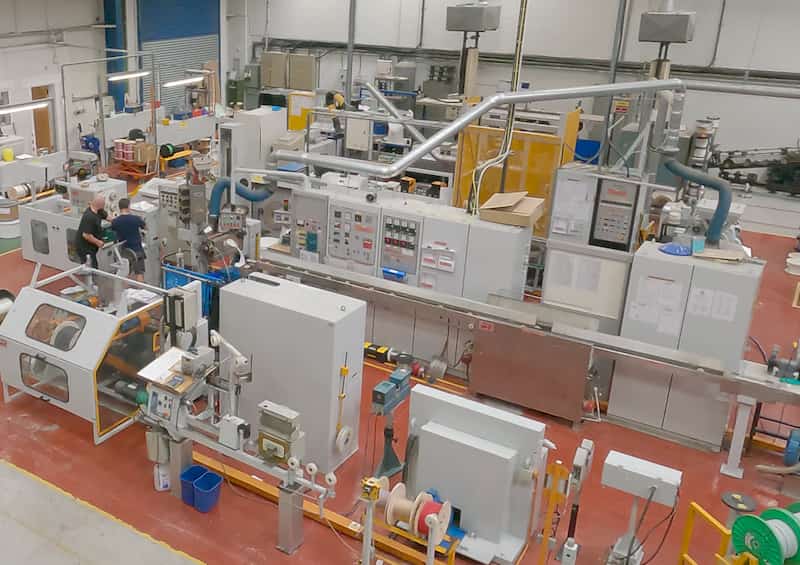
Fluoropolymer extrusion requires specialized equipment due to high processing temperatures and corrosive decomposition products.
Key considerations:
- Screw and Barrel Materials
Recommended materials:
- Hastelloy
- Inconel
- Nickel alloys
- Crosshead Design
For cable insulation:
- Pressure crossheads are preferred
- Concentricity control is critical for dielectric performance
- Temperature Control
Processing temperatures can exceed 380–400°C, requiring:
- High-temperature heaters
- Accurate PID control
Safety
- Overheating fluoropolymers can release toxic gases such as HF and perfluoroisobutylene, requiring adequate ventilation.
11. Conclusion
Fluoropolymers are indispensable materials in high-performance cable systems where conventional insulation materials cannot meet environmental or electrical requirements. PTFE provides unmatched thermal stability but requires specialized processing, while melt-processable materials such as FEP, PFA, and ETFE enable conventional extrusion with varying balances of dielectric performance, mechanical strength and cost. Selecting the appropriate fluoropolymer requires careful evaluation of operating temperature, electrical performance, mechanical requirements, and chemical exposure conditions.