

Overview of PTFE
Polytetrafluoroethylene (PTFE) is a fully fluorinated polymer composed of repeating –CF₂–CF₂– units. It exhibits one of the highest thermal and chemical resistance levels of any polymer used in wire and cable.
However, PTFE cannot be melt-extruded in the conventional thermoplastic sense. Instead it is processed through paste extrusion followed by sintering, which is why PTFE insulation behaves differently from melt-processed fluoropolymers.
Typical PTFE cable uses include:
- Aerospace wiring
- Military wiring
- RF coaxial cables
- High-temperature instrumentation cables
- Key Properties
|
Property |
Typical Value |
| Continuous temperature rating | ~260 °C |
| Melting point | ~327 °C |
| Dielectric constant | ~2.1 |
| Dissipation factor | ~0.0002 |
| Coefficient of friction | Extremely low |
CTA Banner Form
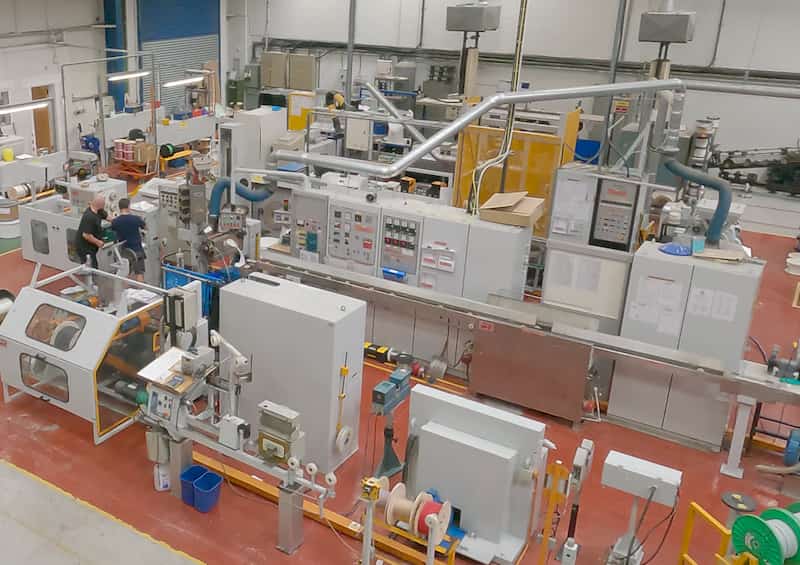
PTFE Extrusion Process (Paste Extrusion)
PTFE is processed using paste extrusion, which involves:
Powder mixing with lubricant
Cold preforming
Ram extrusion
Sintering in a high-temperature oven
Important characteristics of PTFE extrusion:
- The material is never truly molten
- The polymer particles fuse during sintering
- Orientation occurs during extrusion, affecting mechanical properties
This process produces insulation with very low dielectric loss and excellent thermal performance, but also introduces limitations in mechanical strength and production efficiency.
Overview of PFA Fluoropolymer
Perfluoroalkoxy alkane (PFA) is a perfluorinated polymer similar to PTFE but modified with perfluoroalkoxy side chains.
These side chains reduce crystallinity and allow the material to melt flow, making it fully melt-extrudable.
Typical PFA cable applications:
Semiconductor manufacturing equipment
Aerospace wiring
High-purity chemical environments
High-temperature sensors
Key Properties
|
Property |
Typical Value |
|
Continuous temperature rating |
~260 °C |
|
Melting point |
~305 °C |
|
Dielectric constant |
~2.1 |
|
Dissipation factor |
~0.0003 |
|
Flexural strength |
higher than PTFE |
When Engineers Choose PTFE vs PFA
PTFE is chosen when:
-
Ultra-low dielectric loss is required
- RF or microwave performance is critical
- Extreme temperature stability is needed
- Aerospace standards require it
Examples
- RF coaxial cables
- MIL-spec aerospace wires
- microwave antennas
PFA is chosen when:
- High-purity environments are required
- Better mechanical durability is needed
- Melt extrusion production is preferred
- Smooth surface finish is critical
Examples:
- Semiconductor equipment cables
- Chemical processing instrumentation
- High-purity fluid sensor wiring
Key Engineering Insight
The most important difference between the two materials is:
PTFE is a sintered polymer; PFA is a melt-processed polymer.
This affects:
manufacturing method
mechanical structure
surface quality
processing cost
Even though their chemical resistance and temperature ratings are nearly identical, their processing physics and mechanical behavior are fundamentally different.
Conclusion
Even though their chemical resistance and temperature ratings are nearly identical, their processing physics and mechanical behavior are fundamentally different.